Univest App Review 2026: Is This SEBI Registered Advisory App Worth ₹6 a Day?
 By Ankush Sheoran
· July 25, 2026 · Tested hands-on. Some links are affiliate links — scores are never for sale.
By Ankush Sheoran
· July 25, 2026 · Tested hands-on. Some links are affiliate links — scores are never for sale.
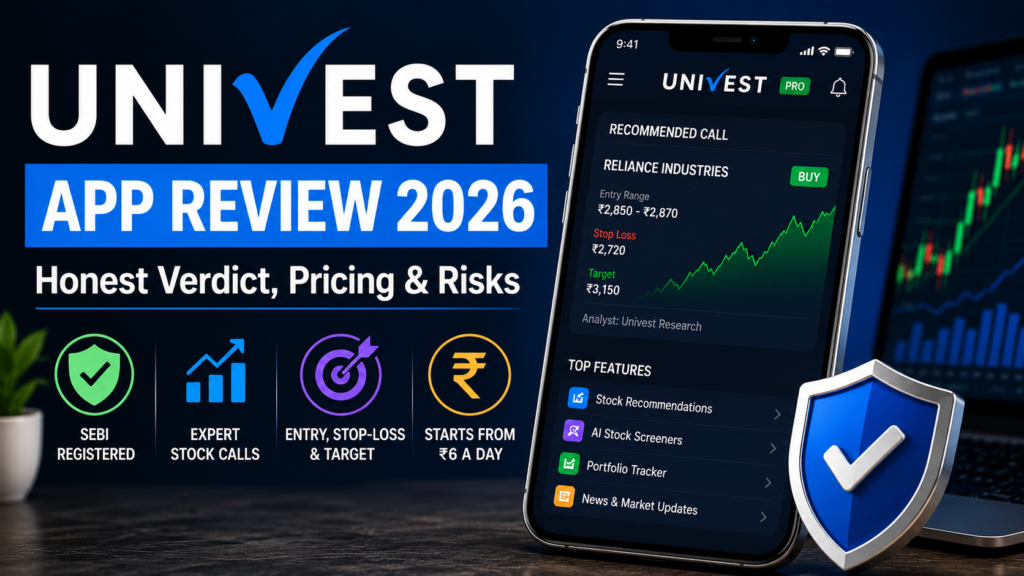
Univest is one of the most heavily advertised stock advisory apps in India right now — YouTube pre-rolls, Instagram ads, and a Play Store listing with more than 10 million downloads. The pitch is simple: instead of guessing which stock to buy, you pay a small subscription and receive research-backed buy, sell and hold calls from SEBI-registered analysts, with entry price, stop-loss and target attached to every recommendation.
That pitch lands because it targets a real gap. Millions of Indians opened demat accounts after 2020, discovered that a broking app gives you execution but no guidance, and went looking for someone to tell them what to buy. Univest sells exactly that.
This review covers what Univest actually is, its regulatory standing, its features, what it costs, what real users complain about, and who should — and shouldn’t — pay for it.
One clarification first: There are two unrelated companies called Univest. This review covers Univest (univest.in), the Gurugram-based Indian stock advisory and broking platform. It is not Univest Financial Corporation, the Pennsylvania bank. If you searched “Univest app review” and landed on complaints about mobile cheque deposits, that’s the other one.
“Properly regulated and well built — but inconsistent disclosures and billing complaints mean you should trial it, not commit.”
Best for: Beginner to intermediate Indian investors who want structured, regulated trade ideas with defined stop-losses, and who are comfortable treating the calls as input rather than instruction.
Skip if: You have a small portfolio, already research your own trades, want managed exposure rather than trade calls, or expect the accuracy figure to become your returns.
- Three verifiable SEBI registrations — research, advisory and broking.
- Every call includes entry, stop-loss and target.
- Named analysts attached to research, as SEBI requires.
- Low entry pricing versus traditional advisory.
- Clean, fast app that even critics praise.
- Research, screening and execution in one place.
- Two different SEBI RA numbers across its own listings.
- 86% accuracy is self-reported, never independently audited.
- Repeated complaints about auto-debit and cancellation.
- Users report heavy outbound sales calling after signup.
- 5.0 rating across 42,000+ reviews isn't a credible distribution.
- Advisory plus brokerage rewards higher trade frequency.
In this review
What Is Univest?
Univest is a stock market advisory platform operated by Univest Communication Technologies Private Limited, headquartered at Unitech Commercial Tower 2, Sector 45, Gurugram, Haryana.
The business is structured across three regulated entities:
| Function | Entity | SEBI registration |
|---|---|---|
| Research advisory | Uniresearch Global Pvt Ltd | INH000013776 (Research Analyst) |
| Investment advisory | Uniapps Investment Adviser Pvt Ltd | INA000017639 (Investment Adviser) |
| Broking / execution | Univest Stock Broking Pvt Ltd | INZ000317437 (Stockbroker) |
That structure matters more than it might appear. In India, giving stock recommendations for a fee without SEBI registration is illegal, and the tip-provider space is full of unregistered Telegram and WhatsApp operators. Univest sits on the regulated side of that line, with grievance redressal obligations, disclosure norms and periodic inspection attached to each registration.
The core product is a subscription — branded Univest Pro — that unlocks analyst-issued trade ideas across equity, futures, options, commodities and mutual funds, plus stock screeners and portfolio tools. Broking was added later, letting subscribers execute a call inside the same app rather than switching to a separate broker.
It is built for retail investors who want direction, not for people who do their own research.
Key Features
SEBI-registered research calls
- What it does: Delivers buy/sell recommendations with a full parameter set — entry price range, stop-loss and target — attributed to named analysts operating under the firm’s Research Analyst registration.
- Why it matters: The parameters are the actual product. A tip without a stop-loss is a gamble; a call with a defined invalidation point is a trade plan. For a beginner who has never sized a position or set an exit, this structure is genuinely educational.
- How it performs: Univest publishes an 86% accuracy figure on closed recommendations. Treat that number carefully. It is self-reported, not audited by a third party, and “accuracy” in advisory usually means the target was hit before the stop-loss — which says nothing about the size of wins versus losses. Several App Store reviewers make a specific and credible criticism here: that options calls are structured with a stop-loss and a target of roughly equal size, meaning a 50% hit rate produces a net loss after costs.
- Limitations: You are receiving mass-distributed research, not personalised advice. The same call goes to every subscriber on that tier simultaneously, which can move price in thinly traded names and makes the published entry price harder to get.
- Use case: A salaried investor who can check the app twice a day, place a position with the stated stop-loss, and let it run — rather than someone trying to scalp intraday calls between meetings.
AI stock screeners
- What it does: Filters the NSE and BSE universe (Univest cites 5,000+ stocks) on parameters like earnings momentum, technical breakouts and sector strength, with saveable and favourited screens.
- Why it matters: Screeners give you a reason to look at a stock before someone tells you to buy it. Used properly, they’re the difference between following calls and understanding them.
- Limitations: Screener depth is a crowded category, and free tools like Screener.in, Trendlyne and TickerTape are strong here. Univest’s screener is a supporting feature, not a reason to subscribe on its own.
Integrated broking
- What it does: A demat and trading account inside the same app, so a recommendation can be executed in one flow, with GTT (Good Till Triggered) orders for automatic entry and exit.
- Why it matters: Slippage between reading a call and placing it on another broker is a genuine cost. Compressing that to one tap is a real advantage.
- Limitations: This creates a structural conflict worth naming plainly. A company that both recommends trades and earns brokerage on them has an incentive toward higher trade frequency. The separate SEBI entities exist partly to manage that conflict, but it doesn’t disappear. Also note that Univest’s own iOS listing at one point described the platform as “not a broker… a pure advisory platform,” which contradicts the broking registration promoted elsewhere. That inconsistency is not reassuring.
Portfolio tracker and buy/sell/hold ratings
- What it does: Imports your holdings and applies a rating to each, flagging positions that research views as deteriorating.
- Why it matters: Exit discipline is where most retail portfolios bleed. Automated exit prompts address a real behavioural weakness.
- Limitations: Ratings are generic, not tailored to your cost basis, tax position or goals. A “sell” prompt that triggers short-term capital gains may not be right for you.
TradeZapp algo baskets and mutual fund advisory
- Pre-built algorithmic strategies and SIP/mutual fund recommendations, added more recently. Both are newer additions with a thinner public track record than the core equity advisory, and should be evaluated on their own rather than assumed to inherit the core product’s quality.
User Experience
The app is, by consistent account, well built. Reviewers across both stores describe a clean, fast interface with information laid out clearly — and this is one of the few areas where positive and negative reviewers agree.
Onboarding is standard Indian fintech: PAN, Aadhaar, bank details, eKYC, with the broking account typically active within a few working hours. Advisory access starts immediately on the trial.
Learning curve is low, which is both the point and the risk. Getting to your first trade idea takes minutes. Understanding whether that idea suits your risk profile takes considerably longer, and the app is optimised for the first thing.
Where the experience breaks down is outside the interface. Two complaint patterns appear repeatedly and specifically:
- Sales pressure. Multiple users report a high volume of calls after signing up — one Play Store reviewer described receiving over 50 calls following registration. If you value a quiet phone, factor this in.
- Subscription and cancellation friction. This is the most serious recurring complaint. Users on Trustpilot and Play Store describe subscriptions converting to auto-debit mandates without clearly understood consent, no obvious in-app unsubscribe option, and slow ticket-based support with multi-day reply times. One reviewer reported a monthly purchase converting to a recurring ECS mandate they hadn’t knowingly agreed to.
The company does respond publicly to negative reviews on both stores, directing users to support@univest.in. Whether those responses resolve anything is not something a review can verify from the outside.
Performance and Testing
Disclosure on method: This review is based on Univest’s public documentation, its App Store and Play Store listings, SEBI registration details, and a reading of user reviews across Google Play, the Apple App Store and Trustpilot as of July 2026. It is not a hands-on subscription test, and no live trades were placed. Where numbers appear below, they are the company’s own claims unless stated otherwise.
That matters, because advisory performance is the one thing that can’t be assessed from a marketing page — and it’s the only thing subscribers are actually buying.
What the public record shows:
- The accuracy claim is unverified. 86% is disclosed by Univest, not audited externally. There is no independent third-party verification of the track record available.
- A specific, technical criticism recurs. Several reviewers allege that reported entry and exit prices are chosen at levels difficult to actually transact at, inflating reported gains relative to what a subscriber achieves after slippage. One June 2026 Play Store reviewer described spending over ₹16,000 on subscriptions and finding results roughly breakeven after slippage and execution delay, despite reports showing profits. This is a common criticism of the entire advisory-calls category, not unique to Univest, but it is the criticism that matters most.
- The ratings picture is implausible. Univest’s Google Play listing shows a 5.0 average across roughly 42,600 reviews. No paid financial product with real subscribers produces a perfect 5.0 at that volume — market losses alone guarantee angry users. Meanwhile the small Trustpilot sample skews sharply negative. When store ratings and independent-platform ratings diverge this far, weight the independent platform more heavily.
Consistency check. Comparing Univest’s own public materials against each other, the following conflicts appear:
| Claim | Variants found across Univest’s own channels |
|---|---|
| User base | 30 lakh, 50 lakh, 5 million, 7.5 million, 1 crore, 80 lakh |
| Free trial | 7-day free, 3-day free, 3-day at ₹1 |
| Brokerage | ₹5 per trade; ₹18 per order after a 30-day free window; zero brokerage on delivery |
| Research Analyst registration | INH000013776 (most listings); INH000015339 (one App Store description) |
Some of this is ordinary marketing drift across pages updated at different times. But for a regulated financial service, inconsistent registration numbers and inconsistent pricing on official listings is a legitimate mark against the platform, and it’s the single strongest reason this review doesn’t rate higher.
Pricing
Pricing accurate as of July 2026 and subject to change — verify in-app before subscribing.
| Plan | Coverage | Indicative pricing |
|---|---|---|
| Free trial | Full advisory access | Advertised as 7-day free, 3-day free, or 3 days at ₹1 depending on listing |
| Pro Lite | Equity stock ideas | From ~₹6/day; roughly ₹183/month on long commitments, ~₹399/month on a 3-month plan |
| Pro Plus | Adds futures | Higher tier; roughly ₹833/month on shorter commitments |
| Pro Alpha | Adds options | Higher tier |
| Pro Super | Equity + futures + options | Roughly ₹1,166/month on a 3-month plan |
| Pro Black | Commodities focus | Higher tier |
| Broking | Demat account | Free account opening; brokerage quoted between ₹5/trade and ₹18/order depending on source, with promotional zero-brokerage windows |
Value assessment: The headline “₹6 per day” is real but requires a multi-year commitment to reach. On a three-month plan, the entry tier lands closer to ₹400/month, and the derivatives tiers run into four figures monthly. That’s still cheap against traditional advisory, and cheap against a single bad trade.
The pricing question isn’t whether ₹6/day is affordable. It’s whether the calls generate more than the subscription plus brokerage plus slippage plus taxes — and on that, the public evidence is genuinely mixed.
Before you subscribe: check the auto-renewal terms and the cancellation path, given the volume of complaints in this specific area. If you subscribe through Google Play, you can manage or cancel the subscription from your Play account rather than relying on in-app support.
Pros and Cons
Pros
- Three active SEBI registrations across research, advisory and broking — verifiable at sebi.gov.in
- Every recommendation carries entry, stop-loss and target, which enforces risk discipline
- Named analysts attached to research, as SEBI requires, rather than an anonymous “expert team”
- Genuinely low entry pricing relative to traditional advisory services
- Clean, fast interface that both supporters and critics praise
- Research, screening and execution in one app, reducing slippage
- Free trial available before payment
Cons
- Inconsistent claims across the company’s own listings, including two different RA registration numbers
- 86% accuracy is self-reported with no independent audit
- Repeated, specific complaints about auto-debit mandates and difficult cancellation
- Reports of aggressive outbound sales calling after signup
- Credible user allegations that reported entry/exit prices are hard to achieve in live markets
- A 5.0 rating across 42,000+ reviews undermines rather than supports credibility
- Advisory plus brokerage creates a structural incentive toward trade frequency
- Much of the content ranking for “Univest review” is published by Univest itself, making independent information harder to find
Comparison With Alternatives
| Platform | Model | Best for | Main trade-off |
|---|---|---|---|
| Univest | Paid advisory + broking | Investors who want to be told what to buy, with defined risk | Unaudited track record; billing complaints |
| Zerodha | Discount broking + free education (Varsity) | Self-directed investors who want to learn | No recommendations at all — you decide |
| Groww / Angel One | Broking with research add-ons | Beginners wanting a simple all-in-one app | Research is lighter and less structured |
| Smallcase | Thematic portfolios by SEBI-registered managers | Long-term investors wanting curated baskets | Portfolio-level, not individual trade calls |
| Screener.in / Trendlyne | Free/low-cost research tools | Investors doing their own analysis | Data and screens only, no recommendations |
The honest framing: Univest competes on doing the thinking for you. If that’s what you want, its regulatory standing puts it ahead of unregistered tip channels. If you’re willing to learn, Zerodha’s Varsity plus a free screener costs nothing and builds a skill that outlasts any subscription. And if you want professional management without picking trades, Smallcase is the more sensible structure.
Who Should Use It?
Good fit
- Beginners who have opened a demat account and don’t know what to do next
- Investors with ₹1 lakh or more deployed, where a subscription is a small percentage of the portfolio
- People who want structured entry/exit discipline imposed on them
- Investors who specifically want a SEBI-registered provider rather than a Telegram channel
Poor fit
- Anyone with a small portfolio, where subscription and brokerage costs eat a large share of returns
- Self-directed investors who already research their own positions
- Anyone hoping for guaranteed or consistent monthly income — no SEBI-registered advisor can legally promise that, and none can deliver it
- Investors who will follow F&O calls without understanding options risk
- Anyone who won’t read the auto-renewal terms carefully
FAQs
Frequently asked questions
Is Univest SEBI registered?
Yes. Its entities hold Research Analyst registration INH000013776, Investment Adviser registration INA000017639, and stockbroker registration INZ000317437. Verify any registration number directly on sebi.gov.in before subscribing — that check takes a minute and applies to every advisory service, not just this one.
Is Univest safe or a scam?
It is a registered, regulated business with a physical office in Gurugram, not a scam operation. That said, "regulated" and "profitable for you" are different questions. The recurring complaints are about billing practices, sales pressure and call quality — not about the company disappearing with your money.
How much does Univest cost?
Entry advisory plans are advertised from about ₹6 per day, roughly ₹183/month on long commitments and closer to ₹400/month on a three-month plan. Derivatives and commodity tiers cost substantially more. Prices as of July 2026.
Does Univest have a free trial?
Yes, though the advertised length varies across its own listings between three and seven days, and one version is priced at ₹1. Check what's actually offered in-app at signup.
Is Univest's 86% accuracy claim real?
It is Univest's own disclosed figure and has not been independently audited. Accuracy in advisory typically counts targets hit versus stops hit, which ignores whether wins are larger than losses. Judge it during the trial, not from the marketing.
How do I cancel a Univest subscription?
This is the most common complaint about the service. If you subscribed via Google Play or the App Store, cancel through your platform subscription settings, which is more reliable than in-app support. If you set up a direct auto-debit or ECS mandate, you may also need to cancel it with your bank and email support@univest.in with a written record.
Is Univest a broker or an advisor?
Both, through separate registered entities — though its own listings have described it inconsistently. Research comes from the Research Analyst entity; execution from the broking entity.
Can Univest guarantee profits?
No. Under SEBI regulations, no registered advisor may guarantee returns. Any service promising fixed profits is either unregistered or violating regulation.
Is Univest better than Zerodha?
They aren't competitors in the same sense. Zerodha is a broker that doesn't tell you what to buy; Univest is an advisory service that does. Many investors use a discount broker for execution and pay separately for research.
Conclusion
- Company identity
- Verified — Univest Communication Technologies Pvt Ltd, Gurugram
- SEBI research licence
- Verified — Uniresearch Global, RA INH000013776
- SEBI advisory licence
- Verified — Uniapps Investment Adviser, IA INA000017639
- SEBI broking licence
- Verified — Univest Stock Broking, INZ000317437; NSE/BSE/MCX member
- Registered office
- Verified — Unitech Commercial Tower 2, Sector 45, Gurugram
- Named compliance officers
- Verified — published with contact emails for each entity
- Fund custody
- Safe — demat held with CDSL/NSDL, not pooled by the company
- Enforcement action
- None found in public searches (not exhaustive)
- Guaranteed-return claims
- None found — consistent with SEBI rules
- Performance claims
- Unverified — 86% accuracy is self-reported, never externally audited
- Disclosure consistency
- Poor — two different RA numbers and six different user counts across its own listings
- App store ratings
- Implausible — 5.0 average across 42,000+ Play Store reviews
- Billing practices
- Complaints — recurring reports of auto-debit mandates and blocked cancellation
- Sales conduct
- Complaints — users report heavy outbound calling after signup
- Operating history
- Short — regulated entities incorporated 2023–24
Verdict: Univest is a real, SEBI-registered company, not a fake app — your money sits with CDSL/NSDL, not in a company wallet, and no regulatory action against it surfaced in public records. The risk here isn't fraud, it's accuracy and billing. Its 86% accuracy figure has never been independently audited, its own listings publish conflicting registration numbers and user counts, and the most consistent complaint from paying users is difficulty stopping the subscription. Verify the registration numbers yourself at sebi.gov.in, use the free trial before paying, and if you do subscribe, do it through Google Play or the App Store so you can cancel from your platform account rather than through support tickets.
What holds the score down isn’t the product. It’s the marketing hygiene around it. A regulated financial service publishing two different registration numbers, four different user counts and three different trial offers across its own official listings is not a small detail — it’s the kind of carelessness that makes an unaudited 86% accuracy claim hard to take at face value. Add the volume of specific, consistent complaints about auto-debit and cancellation, and a 5.0 store rating that no honest paid financial product achieves, and a reasonable person should approach with the trial rather than the annual plan.
Choose Univest if you’re a beginner or intermediate investor who wants structured, regulated trade ideas with defined risk, you have enough capital deployed that the subscription is marginal, and you’ll treat the calls as research input rather than instructions.
Look elsewhere if you have a small portfolio, you’re already comfortable doing your own research, you want managed exposure rather than trade calls, or you’re expecting the accuracy figure to translate into your returns.
Practical advice: take the free trial, paper-trade the calls for its full duration, and compare the entry prices you could actually have achieved against the ones reported. That single test answers more than any review can — including this one.
Disclaimer: This article is for informational purposes only and does not constitute investment advice or a recommendation to buy, sell or subscribe to any product. Investments in securities markets are subject to market risks; read all related documents carefully before investing. Past performance is not indicative of future results. Pricing, features and registration details were accurate as of July 2026 and may have changed. Verify SEBI registration numbers at sebi.gov.in and consult a qualified financial advisor before making investment decisions.

Ankush is the founder and editor of Review Padho, an independent review site covering apps, software and financial platforms for Indian users. He started the site after getting tired of "reviews" that were just affiliate pages with a score attached. Every review here starts with the actual product — the pricing page, the app store complaints, the fine print in the terms — and says plainly when something doesn't add up. Ankush is not a SEBI-registered investment advisor, and nothing on Review Padho is investment advice. Reviews may contain affiliate links, which never affect the verdict.
All reviews by this author →Related reviews
Gullak App Review 2026: Is Digital Gold Saving Safe After SEBI’s Warning?
A genuinely good savings habit wrapped around an unregulated product — fine for jewellery goals, wrong for investing.

Big Mumbai Game Real or Fake? What We Found (2026)
The app is real; the operator isn't traceable, and the whole category has been prohibited in India since October 2025.
Reader reviews
Used this tool? Your rating counts toward the aggregate score shown to search engines.